
Updated September 2026 | Legal information current under the Road Rules 2014 (NSW) as amended from 1 July 2024
Do Children Need a Car Seat or Booster on a Bus in NSW?
Parents booking a charter coach, airport transfer or school excursion in Sydney nearly always ask the same question: does my child legally need a baby seat, capsule or booster on the bus? The short answer is no, not on a vehicle that NSW law classes as a bus. The longer answer matters more, because the law changed in 2024, the rules for 12-seat minibuses are completely different, and passengers aged 16 and over can still be fined for ignoring a fitted seatbelt.
This guide replaces our earlier article on baby seat and child restraint laws in buses and has been rewritten against current NSW legislation and Transport for NSW guidance. It explains exactly who is responsible for restraining children, what changed when seatbelt cameras arrived, how the rules apply to minibuses, coaches and school buses, and what Sydney Charter Bus Australia recommends for families travelling with babies and young children.
Key Points at a Glance
- In NSW, a bus is a motor vehicle that seats more than 12 adults, including the driver.
- Since 1 July 2024, rule 264-1 of the Road Rules 2014 makes drivers responsible for passenger restraints, but it does not apply to bus passengers.
- Child car seats and boosters are not legally required on buses, but Transport for NSW recommends them.
- Buses are not required to have child restraint anchorage points, or to supply car seats.
- Passengers aged 16 and over must wear a seatbelt where one is fitted, and can be fined by NSW Police.
- In a 12-seat minibus, the vehicle is not a bus, so the full child car seat laws apply.
- Never share a seatbelt with a child or nurse a baby inside your own belt.
What Counts as a Bus Under NSW Law?
Everything turns on the definition of a bus. The Passenger Transport Act 2014 (NSW) defines a bus as a motor vehicle that seats more than 12 adults. The Road Rules 2014 use the same test: a vehicle built mainly to carry people that seats over 12 adults, including the driver. In practical terms, that means 13 or more seats including the driver’s seat.
The seating capacity recorded on the vehicle’s compliance plate and registration is what counts, not how many passengers happen to be on board. A 14-seat Toyota Hiace Commuter carrying six people is still a bus. A 12-seat Mercedes Sprinter carrying twelve people is not.
Licensing follows the same line. A Class C car licence covers vehicles that seat up to 12 adults including the driver. Anything seating more than 12 adults requires at least a Light Rigid (LR) licence.
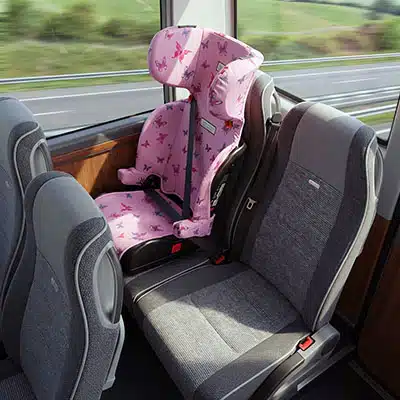
Vehicle Size, Licence and Child Restraint Law Compared
| Vehicle | Seats (incl. driver) | Licence class | Paid passenger law | Child car seat laws apply? |
|---|---|---|---|---|
| Private car, SUV or people mover | Up to 12 | C | Not applicable (private) | Yes, driver responsible |
| Rideshare or hire vehicle (incl. 12-seat minibus) | Up to 12 | C | Point to Point Transport (Taxis and Hire Vehicles) Act 2016 | Yes, driver responsible |
| Taxi | Up to 12 | C | Point to Point Transport Act 2016 | Modified, taxi rules apply (see below) |
| Minibus, e.g. 14-seat Hiace Commuter, 20-seat Coaster | 13 or more | LR (up to 8t GVM) | Passenger Transport Act 2014 | No, recommended only |
| Midi-coach, coach, HI-CAP coach | 13 or more | MR or HR | Passenger Transport Act 2014 | No, recommended only |
The Law: Road Rules 264-1, 265, 266 and 267
Our original article pointed readers to rule 266 of the Road Rules 2014, which at the time read: “The driver of a motor vehicle (except a bus or motor bike) … must ensure that this rule is complied with for each passenger … who is under 16 years old.” That wording no longer appears in NSW law.
The Road Transport Amendment (Automated Seatbelt Enforcement) Rule 2024, which commenced on 1 July 2024, removed rule 266(1) and inserted a new NSW-only rule, rule 264-1. It requires the driver of a moving motor vehicle to ensure each passenger complies with rules 265 or 266, carrying a maximum court penalty of 20 penalty units. Crucially, subrule 264-1(2)(a) states that this duty does not apply in relation to a bus passenger. The bus exemption survived the reform, it simply moved.
| Rule | What it covers | How it applies on a bus |
|---|---|---|
| 264 | Drivers must wear a properly adjusted and fastened seatbelt | Applies to the bus driver |
| 264-1 (from 1 July 2024) | Driver must ensure passengers comply with rules 265 and 266 | Does not apply to bus passengers, rule 264-1(2)(a) |
| 265 | Passengers aged 16 or older must wear a fitted seatbelt, properly adjusted and fastened, and must not share a seating position | Applies, the passenger is personally liable |
| 266 | Age-based child restraint requirements for passengers under 16 (rear-facing, harness, booster) | The driver’s enforcement duty under rule 264-1 does not extend to buses |
| 267 | Exemptions from wearing seatbelts, including medical certificates and bus passengers on buses designed for standing passengers where all belted positions are occupied | Limited exemption for route-style buses carrying standees |
Child Restraint Requirements by Age: Cars Versus Buses
Under the national child restraint rules adopted in NSW, the driver of a car must ensure children are in an approved restraint meeting Australian/New Zealand Standard AS/NZS 1754 that suits their age and size. The graphic below shows those age bands. On a bus with 13 or more seats, none of these bands is legally mandatory, yet every one of them still represents the safest way for that child to travel.
Proportional to age in years. Source: NSW Government, Child car seats and Child Car Seats, Legal requirements.
| Age | Private car or 12-seat minibus (legal requirement) | Accredited bus or coach, 13+ seats (legal position) | SCBA recommendation |
|---|---|---|---|
| Under 6 months | Approved rear-facing restraint, not in front row | No legal requirement | Bring a rear-facing capsule, confirm an anchorage point at booking |
| 6 months to under 4 years | Approved rear or forward-facing restraint with inbuilt harness, not in front row | No legal requirement | Bring your own harnessed seat, sit in the rear rows |
| 4 to under 7 years | Forward-facing harness or approved booster with lap-sash belt | No legal requirement | Bring a booster and use it with the coach’s lap-sash belt |
| 7 to under 16 years | Booster if too small, otherwise properly fastened seatbelt | No legal requirement | Wear the fitted seatbelt on every SCBA vehicle |
| 16 years and over | Must wear seatbelt, rule 265 | Must wear a fitted seatbelt, rule 265 | Seatbelt worn at all times while moving |
Babies and Infants: Laps, Arms and Shared Seatbelts
The old version of this article stated that a parent “will have to nurse the infant”. That was never a legal requirement, and it is not the safest option. Because the driver’s restraint duty does not reach bus passengers, no road rule forces a parent to use a capsule on a coach. However, the NSW Government is explicit about the risks:
“You must not put a seatbelt around both yourself and a child on your lap. The child can be easily crushed. You must not carry a child in your arms in a vehicle. In a crash the child can be crushed, thrown around in the vehicle, or thrown out of the vehicle.”
Rule 265 also prohibits a passenger aged 16 or over from sharing a seating position with another passenger. A parent who wraps their own belt around a baby is exposing the child to crush injuries in a sudden stop, which is the very scenario that seatbelts exist to manage.
Where a baby is travelling on a coach, the safest options are, in order:
- A rear-facing capsule secured in a seat with a suitable child restraint anchorage point, fitted to the manufacturer’s instructions.
- Where no anchorage is available, a capsule or convertible seat installed with the coach’s lap-sash belt where the manufacturer permits a belt-only installation.
- As a last resort, the infant held by a seated adult in a rear row, with the adult’s own seatbelt worn around the adult only.
Bringing Your Own Baby Seat or Booster on a Charter Bus
Transport for NSW guidance, echoed by Raising Children Network, is clear that buses are not required to have car seat anchorage points and do not have to provide or install car seats. If you want your child to use a restraint on a bus, you supply and fit it yourself. Most coaches are built without the top-tether anchorages found in passenger cars, unless an operator has had them installed and certified.
Before you travel, run through this checklist:
- Tell us at the quote stage. Note the number and type of restraints on your online quote request so we can allocate a suitable vehicle and seating position.
- Check the standard. Only restraints marked AS/NZS 1754 are approved for use in Australia.
- Boosters need a lap-sash belt. NSW guidance warns never to use a booster seat with a lap belt alone. All SCBA seatbelts are lap-sash in passenger seating positions designed for them, but confirm with us for the specific vehicle.
- Heavier boosters need anchoring. Booster seats heavier than 2kg must be attached to an anchorage point in cars. On a coach without anchorages, choose a lightweight booster designed for belt-only use.
- Harnessed seats and capsules. Most require a top tether. Check your manufacturer’s instructions for a belt-only installation mode.
- Get it fitted properly. Practise installation beforehand or visit an authorised restraint fitting station.
- Return trips. On single-day charters, restraints can generally remain on board between legs by arrangement with your driver.
Minibuses: Why the 12-Seat Line Changes Everything
A 12-seat minibus, such as a 12-seat Toyota Hiace or Mercedes Sprinter, is not a bus under NSW law. That has three consequences families often overlook:
- Full child car seat laws apply. Children under 7 must be in an approved restraint suitable for their age and size, children under 4 cannot sit in the front row, and the driver carries the legal responsibility under rule 264-1.
- A different passenger law applies. The Point to Point Transport (Taxis and Hire Vehicles) Act 2016 governs paid passenger services in vehicles that are not buses. The taxi concessions do not extend to hire vehicles.
- A Class C licence is sufficient to drive it, which is why the category is so popular for self-drive hire.
Converting a 14-Seat Minibus to 12 Seats
Removing seats to bring a 14-seat Hiace Commuter under the 12-seat threshold is not a matter of unbolting two seats. Transport for NSW’s Vehicle Standards Information No. 6 lists “altering the seating capacity of a bus from 14 seats to 12 seats” as a significant modification requiring certification by a licensed certifier under the Vehicle Safety Compliance Certification Scheme (VSCCS). Because the change reclassifies the vehicle, the certifier must assess compliance with the Australian Design Rules that apply to the new category, which can include child restraint anchorage requirements. Folding or stowing seats does not change the vehicle’s certified capacity. Once certified at 12 seats, every child restraint obligation for cars applies to that vehicle.
Bus Operator Accreditation and Number Plates
Under the Passenger Transport Act 2014, any business operating a public passenger bus service in NSW must be accredited by Transport for NSW. Accreditation falls into two broad streams, and the plates on the vehicle usually tell you which one you are riding in.
| Accreditation stream | Typical services | Common plates | Seatbelts fitted? |
|---|---|---|---|
| Regular Passenger Services (RPS) | Contracted route and timetabled services, including Sydney metropolitan and outer metropolitan buses | m/o or MO plates | Usually not on urban route buses, which carry standing passengers |
| Long Distance, Tourist and Charter (LDTC) | Charter hire, tours, airport transfers, excursions, long distance coaches | TV (tourist vehicle) plates | Coaches built to ADR 68 are fitted with seatbelts |
Service NSW issues TV plates only for vehicles that seat more than 12 adults and are used for tourist, charter or long distance services under passenger transport accreditation. Operators providing a public passenger service for 13 or more passengers must also have a vehicle monitoring device fitted, with limited exemptions for contracted route buses (Transport for NSW, Industry information for bus operators). Always check that your operator’s accreditation is genuine. Our accreditation page explains how to verify it.
Seatbelts on Buses: What Passengers Must Do
Transport for NSW puts it plainly in its bus safety material: “If a bus has seatbelts it is the law to wear one” (Seatbelt safety on the bus fact sheet). For passengers aged 16 and over, rule 265 makes non-compliance an offence for which NSW Police can issue a fine. Current amounts are listed on the NSW offences and penalties search.
Seatbelt detection cameras began issuing fines on 1 July 2024. They check light and heavy vehicles, including buses, but Transport for NSW confirms that drivers of buses and taxis are not fined by cameras for passengers who fail to wear a seatbelt. The responsibility sits with the passenger, or for children, with the parent or supervising adult.
Why It Matters: Unbelted Occupants Killed or Seriously Injured in NSW Each Year
Annual average of drivers and passengers not wearing available seatbelts, 2020 to 2024. Source: Transport for NSW, Seatbelts. Wearing a seatbelt correctly doubles the chance of surviving a crash.
School Buses: The Regional Seatbelt Program Is Complete
The earlier article noted that NSW was funding seatbelts on regional and rural school buses by December 2021. That program has since finished. In March 2022 the NSW Government announced that every dedicated school bus on rural and regional contracts had been fitted with seatbelts, two years ahead of schedule, under the $237 million NSW Rural and Regional Bus Seatbelt Program (NSW Government media release). An extension covering 92 dedicated school buses on higher-risk outer metropolitan roads in the Hunter was completed in 2024.
Sydney metropolitan route buses remain largely unbelted because they are designed to carry standing passengers. Chartered school excursion coaches are a different category, and every SCBA vehicle used for school excursion bus hire is seatbelted.
Seatbelt-Fitted Dedicated School Buses by Program
Rural and regional program: 2,583 buses (96.6%)
Hunter outer metropolitan extension: 92 buses (3.4%)
Source: NSW Government announcements, 2022 and 2024.
Prams, Strollers and Loose Items on Charter Coaches
No NSW road rule treats a pram as a child restraint on any bus. On a charter coach, a baby in a pram is unrestrained, and the pram itself can become a projectile under heavy braking. For that reason SCBA requires prams and strollers to be folded and stowed in the luggage bay or secured where the driver directs. Children should be moved into a seat, ideally in their own restraint, before the vehicle moves. Wheelchair and mobility aid arrangements are covered separately on our accessibility page.
How Sydney Charter Bus Australia Transports Children
- Every vehicle in our fleet, from 12-seat minibuses to 62-seat HI-CAP coaches, is fitted with seatbelts and TfNSW accredited.
- On our 12-seat minibuses, the full NSW child car seat laws apply. Parents must supply an approved restraint for every child under 7.
- On minibuses and coaches with 13 or more seats, we strongly recommend age-appropriate restraints and require every passenger to wear the fitted seatbelt.
- Families are seated in the rear rows first where possible, away from the front row and door area.
- Schools and group organisers can review our school transport safety policy and student transport risk assessment.
Frequently Asked Questions
Is it illegal for a child to travel without a car seat on a bus in NSW?
No. On a vehicle seating more than 12 adults, the driver’s duty under rule 264-1 to ensure children are restrained does not apply. It remains strongly recommended.
Can my baby sit on my lap on a coach?
It is not prohibited on a bus, but it is the least safe option. Never place your seatbelt around the baby. Use a capsule where possible.
Does the bus company provide baby seats?
Operators are not required to supply them. Please bring your own and tell us when booking so we can plan seating.
Does my teenager have to wear a seatbelt on a charter bus?
Passengers aged 16 and over must wear a fitted seatbelt under rule 265 and can be fined. Younger teens should wear one too, and SCBA requires it.
Are the rules different in a 12-seat minibus?
Yes. A 12-seat minibus is not a bus, so all child car seat laws apply and the driver is legally responsible.
More answers are on our FAQs page, or contact our team for vehicle-specific advice.
Legislation and Further Reading
| Legislation or guidance | Relevance |
|---|---|
| Road Rules 2014 (NSW), Part 16, rules 264 to 267 | Seatbelt and child restraint obligations, and the bus exemption |
| Road Transport Amendment (Automated Seatbelt Enforcement) Rule 2024 | Inserted rule 264-1 and removed rule 266(1) from 1 July 2024 |
| Passenger Transport Act 2014 (NSW) | Definition of bus and operator accreditation |
| Point to Point Transport (Taxis and Hire Vehicles) Act 2016 (NSW) | Paid passenger services in vehicles with 12 or fewer seats |
| New South Wales Consolidated Regulations (AustLII) | Free access to consolidated NSW regulations |
| NSW Government, Child car seats | Age-based restraint rules, taxis and exemptions |
| Transport for NSW, Seatbelts | Seatbelt cameras, penalties and bus driver exemption from camera fines |
| Transport for NSW, VSI 06 Light vehicle modifications | Certification of seating capacity changes |
Disclaimer
The information in this article is a general interpretation of NSW legislation and Transport for NSW guidance as at September 2026. It is not legal advice. Laws, penalty amounts and government guidance change, so readers should confirm the current position with the NSW Legislation website and Transport for NSW before relying on it. See rule 266 and the surrounding Part 16 provisions here: legislation.nsw.gov.au/view/html/inforce/current/sl-2014-0758#sec.266. Sydney Charter Bus Australia accepts no liability for any loss arising from reliance on this information. Our full disclaimer is available here.