
Emergency & Incident Management Policy
How We Prepare For, Respond To and Report Incidents, Aligned With Transport for NSW Requirements
On the rare occasion something goes wrong on a service, what matters is that it is handled calmly, safely and correctly. Sydney Charter Bus Australia maintains clear procedures for managing emergencies and incidents, from a minor delay to a serious safety event, and for reporting them to the right authorities in the right timeframe. Our approach aligns with the Transport for NSW Bus Operator Accreditation Scheme and the reporting duties set by the Office of Transport Safety Investigations.
This page explains how we prepare, how we respond, and how we report. It reflects our obligations under NSW passenger transport law and work health and safety law, and it sits alongside our on-the-day incident process. To report a service matter, see our Service Incident page.
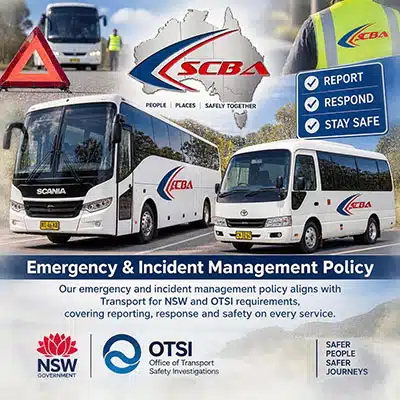
🚨 Prepared | Rapid, Calm Response | Reported Correctly to NSW Authorities
Our Approach
Safety is managed, not left to chance. As an accredited NSW bus operator, we maintain a Safety Management System, and emergency and incident management is a core part of it. Two things guide everything in this policy: protect life and safety first, then report and act so the same thing is less likely to happen again. Every driver knows that in any emergency, the safety of passengers and other road users comes before the schedule, the vehicle or anything else.
The Framework We Work Within
Incident and emergency management for NSW bus operators is governed by a clear set of laws and oversight bodies. We align our procedures to all of them.
| Framework or Body | Role |
|---|---|
| Passenger Transport Act 1990 & Passenger Transport (General) Regulation 2017 (NSW) | Define the safety occurrences that a bus operator must report, and underpin bus operator accreditation. |
| Transport for NSW Bus Operator Accreditation Scheme (BOAS) | Requires accredited operators to maintain a Safety Management System, including incident reporting and emergency management. |
| Office of Transport Safety Investigations (OTSI) | The independent body that receives and investigates significant bus safety occurrences in NSW. |
| Work Health and Safety Act 2011 (NSW) & SafeWork NSW | Require notification of a death, serious injury or dangerous incident at work. |
| Heavy Vehicle National Law | Governs heavy vehicle safety, including driver fatigue and roadworthiness. |
This is a plain-language summary for information only and is not legal advice. Bus reporting requirements are set out by the Office of Transport Safety Investigations.
On-the-Day Emergency Response
When an emergency happens, our drivers follow a clear order of priorities. The steps below apply to a collision, breakdown, fire, medical emergency or any serious event.
| 1. Make it safe | Stop safely, secure the vehicle, and protect passengers and other road users from further harm. |
| 2. Call for help | In any life-threatening situation, call emergency services on 000 first. Render reasonable assistance and first aid within the driver’s training. |
| 3. Account for everyone | Carry out a head count and check for injuries. On school and organised-care services, confirm every child is accounted for. |
| 4. Notify the office | Contact our operations team, who coordinate support, a relief vehicle if needed, and communication with the school, client or families. |
| 5. Preserve and record | Where safe and appropriate, preserve the scene and record what happened to support reporting and investigation. |
Occurrences We Must Report Immediately to OTSI
NSW law requires bus operators to report certain significant safety occurrences to the OTSI Duty Officer immediately, available 24 hours a day. We treat this as an absolute duty. The occurrences that must be reported immediately include:
| A person being fatally injured |
| The driver of the bus being incapacitated |
| Fire or an explosion on the bus |
| A failure of the steering or brakes of the bus |
| A bus being in motion while not under the effective control of a driver |
| A person being caught in the doors of the bus while the bus is in motion |
| A collision where the bus requires towing |
| A collision where a pedestrian is struck and seriously injured |
| A school child being seriously injured, including children in organised care |
| A child left on a bus unattended, while in organised care |
| Any other accident or incident likely to generate immediate or intense public interest or concern |
OTSI Duty Officer: 1800 677 766 (24 hours). If in doubt, we report. We never delay a report because information is incomplete.
Other Reportable Occurrences
Beyond the immediate-notification list, the Passenger Transport (General) Regulation 2017 requires an operator to report an incident that involved or resulted in any of the following. We report these as required, and we also report anything that, in our reasonable opinion, is likely to create serious public concern.
| A person being injured |
| The driver of the bus being incapacitated |
| A mechanical or electrical fire, or an explosion on the bus |
| A failure of the steering or brakes of the bus |
| A bus being in motion while not under the effective control of a driver |
| The bus being unable to continue its journey |
| A person being caught in the doors of the bus and being dragged by the bus |
Where OTSI requests it, we complete and submit the relevant bus incident investigation report within the required timeframe.
Who We Notify, and When
Different events go to different authorities. Our operations team knows the pathways and acts on them promptly.
| Who | Contact | When |
|---|---|---|
| Emergency services | 000 | Any life-threatening situation, fire, or serious injury, first. |
| OTSI Duty Officer | 1800 677 766 | Immediately, for a significant safety occurrence (see list above). 24 hours. |
| SafeWork NSW | 13 10 50 | Immediately, for a workplace death, serious injury or dangerous incident. |
| The school, client or families | Via our operations team | As soon as practicable, kept informed throughout. |
| Our insurer | Via management | For any incident involving injury or damage. |
Investigation and Learning
Reporting is only half the job. Under our Safety Management System, an incident is recorded, investigated to an appropriate level, and used to check and improve our controls so the risk is reduced in future. Where OTSI or another authority requests information or an investigation report, we cooperate fully and provide it within the required timeframe. Serious matters are reviewed by management, and any lesson learned is fed back into our procedures, driver briefings and training. Our on-the-day reporting process for clients and passengers is set out on our Service Incident page.
Prevention and Preparedness
The best incident is the one that never happens. Much of our safety effort goes into preventing emergencies in the first place, and into being ready if one occurs.
| Roadworthy vehicles | Regular servicing and heavy vehicle inspections keep the fleet mechanically sound, reducing the risk of breakdown, fire and brake or steering failure. |
| Fatigue management | Our drivers work to a strict fatigue policy of a maximum of three hours driving before a break of at least twenty minutes, tighter than the standard heavy vehicle limits, because a rested driver is a safer driver. |
| Trained, accredited drivers | Drivers hold the required licences and authorities and are experienced in managing passengers calmly in difficult situations. |
| Onboard safety equipment | Vehicles carry the safety equipment required for their class, and drivers know how to use it. |
| After-hours contact | An after-hours contact service means help and coordination are available whenever a service is running, not only in office hours. |
See our Accreditation and Driver Fatigue Compliance policies.
Our Commitment
Emergencies are rare, but being ready for them is not optional, it is part of running a professional, accredited bus service. When you travel with Sydney Charter Bus Australia, you can be confident that our drivers know exactly what to do if something goes wrong, that the safety of passengers always comes first, and that we meet our reporting duties to the NSW authorities in full and without delay. That readiness is one of the quiet reasons a professional operator is worth choosing.
Questions About Our Safety Standards?
We are happy to talk through our safety, emergency and incident procedures with any school, client or organisation.
NSW Accreditation No. 39461 | Operating Since 2003 | Ph: 1300 468 199 | Mobile: 0413 182 999