
National Road Safety Week
National Road Safety Week is an annual initiative of the Safer Australian Roads and Highways (SARAH) Group, held each May in partnership with road safety organisations and governments across the country. The week shines a light on the human cost of road trauma and, just as importantly, on the many ways we can all work together to keep everyone safer on our roads.
Road safety is a shared responsibility. Every one of us, whether we drive, ride, cycle or walk, has a part to play in protecting not only ourselves but the people around us, including the most vulnerable road users. This guide explains what National Road Safety Week is, the story that started it, the pledge at its heart, Australia’s long-term road safety goals, and the simple actions that make a genuine difference. Sydney Charter Bus Australia is proud to support the campaign every year.
The story behind the week
National Road Safety Week was created by Peter Frazer OAM after a tragedy that no family should ever endure. In 2012, his 23-year-old daughter Sarah had pulled over on the Hume Highway in New South Wales with car trouble. As she and a tow-truck operator stood beside her vehicle waiting for help, both were struck and killed by a passing truck in a crash that was entirely avoidable.
In his grief, Peter founded the SARAH Group, Safer Australian Roads and Highways, and created the yellow ribbon as the nation’s road safety symbol. Sarah’s story is also why protecting people who are stopped at the roadside sits at the very heart of the campaign.
Drive So Others Survive: the pledge
The message at the centre of National Road Safety Week is simple and powerful: Drive So Others Survive. Taking the pledge is a personal commitment to take responsibility on the road and to protect every life, every time you drive. It asks each of us to:
- Drive to the conditions and never speed.
- Put the phone away and never drive distracted.
- Never drive under the influence of alcohol or drugs.
- Make sure everyone is buckled up, every seat, every trip.
- Slow down and take care around vulnerable road users and anyone stopped at the roadside.
You can take the pledge, order a yellow ribbon and download campaign resources at the official National Road Safety Week site, roadsafetyweek.com.au, and learn more about the movement at www.sarahgroup.org.
Australia’s goal: Vision Zero and the Safe System
National Road Safety Week supports a much bigger national goal. Under the National Road Safety Strategy 2021 to 2030, Australian governments have committed to Vision Zero: no deaths or serious injuries on our roads by 2050. As a step toward that goal, the strategy aims to cut annual road deaths by at least 50 per cent and serious injuries by at least 30 per cent by 2030.
That goal is built on the Safe System approach, which recognises that people make mistakes and that the whole road system should be designed so a mistake does not cost a life.
| Safe System pillar | What it means |
|---|---|
| Safe roads | Roads and roadsides designed to prevent crashes and reduce harm when they do happen. |
| Safe speeds | Speed limits matched to the road so that a crash is survivable. |
| Safe vehicles | Well-maintained vehicles fitted with modern safety features. |
| Safe road users | Alert, unimpaired, licensed people who obey the road rules. |
The biggest risks, and what you can do
Most serious crashes come back to a small number of behaviours, often called the fatal five. The good news is that every one of them is within our control.
| Risk | What you can do |
|---|---|
| Speeding | Stick to the limit and slow down for weather, traffic and roadworks. |
| Distraction | Put the phone away. No texting, scrolling or handling the phone while driving. |
| Alcohol and drugs | Never drive impaired. Plan a sober ride home before you go out. |
| Fatigue | Rest well before a long trip, share the driving, and stop to break regularly. |
| No seatbelt | Belt up on every trip, in every seat. Check that your passengers do too. |
Protecting vulnerable road users and roadside workers
Pedestrians, cyclists and motorcyclists have little protection in a crash, and so do the emergency, tow and roadside workers who do their jobs beside fast-moving traffic. Protecting them is exactly what Sarah’s story reminds us to do.
In New South Wales, the Slow Down Move Over rule requires drivers to slow to 40 km/h when passing any stationary emergency vehicle, tow truck or breakdown assistance vehicle displaying flashing lights, then move over safely where they can. It is a small act that saves lives. Giving room to people on foot, on bikes and at the roadside is one of the clearest ways to Drive So Others Survive.
Road safety in New South Wales
New South Wales shares the national Vision Zero goal through its Towards Zero approach, working to eliminate death and serious injury on NSW roads. Hundreds of lives are still lost on NSW roads in a typical year, with speed a factor in a large share of them and a heavy toll on regional roads. Behind every number is a person and a family, which is the message of the Transport for NSW road safety program and its real-life crash stories. Up-to-date figures are published by Transport for NSW.
How professional bus operators keep our roads safer
Charter bus and coach operators carry a special responsibility, moving thousands of passengers, including school students, every day. At Sydney Charter Bus Australia, road safety is built into how we operate, not just something we mark once a year:
- Accreditation. We hold Transport for NSW Bus Operator Accreditation No. 39461 and work under a Safety Management System, with regular independent auditing.
- Seatbelts and safe vehicles. Every vehicle in our fleet is fully seatbelted and air-conditioned, and maintained to strict schedules.
- Driver fatigue management. Our own fatigue policy caps continuous driving at three hours before a minimum 20-minute break, going beyond the standard requirements.
- Professional, authorised drivers. Every service is operated by an authorised NSW driver who signs on to a mandatory pre-departure safety check.
You can read more about our team and our approach on our about us page.
How you can get involved
- Take the pledge to Drive So Others Survive at roadsafetyweek.com.au.
- Wear or display a yellow ribbon, the national symbol of road safety.
- Light up yellow. Homes, workplaces and landmarks turn yellow during the week to show support.
- Download and share the campaign resources with your workplace, club or school.
- Follow the yellow ribbon relay and the campaign on social media, and share the message using #NRSW and #DriveSOS.
Every year our drivers wear yellow ribbons and we encourage our friends, family and passengers to show their support. Let’s all work towards zero deaths on New South Wales roads.
National Road Safety Week FAQs
When is National Road Safety Week held?
It is held each year in May. The exact dates for the current year are published at roadsafetyweek.com.au.
Who runs National Road Safety Week?
It is an initiative of the SARAH Group, Safer Australian Roads and Highways, founded by Peter Frazer OAM, in partnership with road safety organisations and governments.
What does “Drive So Others Survive” mean?
It is a pledge to take responsibility on the road and protect every life, every time you drive, by not speeding, not driving distracted or impaired, buckling up, and taking care around vulnerable road users.
What is the yellow ribbon?
The yellow ribbon is Australia’s national road safety symbol. Wearing or displaying one shows your support for reducing road trauma.
What is Vision Zero?
Vision Zero is the goal of zero deaths and serious injuries on our roads by 2050. The National Road Safety Strategy targets a 50 per cent cut in deaths and a 30 per cent cut in serious injuries by 2030 along the way.
What is the Slow Down Move Over rule in NSW?
Drivers must slow to 40 km/h when passing a stationary emergency vehicle, tow truck or breakdown assistance vehicle showing flashing lights, then move over safely where possible.
How do professional bus operators support road safety?
Through accreditation and safety management systems, fully seatbelted and maintained vehicles, strict driver fatigue management, and professional authorised drivers.
How can I get involved?
Take the pledge, wear a yellow ribbon, light up yellow, share the campaign resources, and use #NRSW and #DriveSOS on social media.
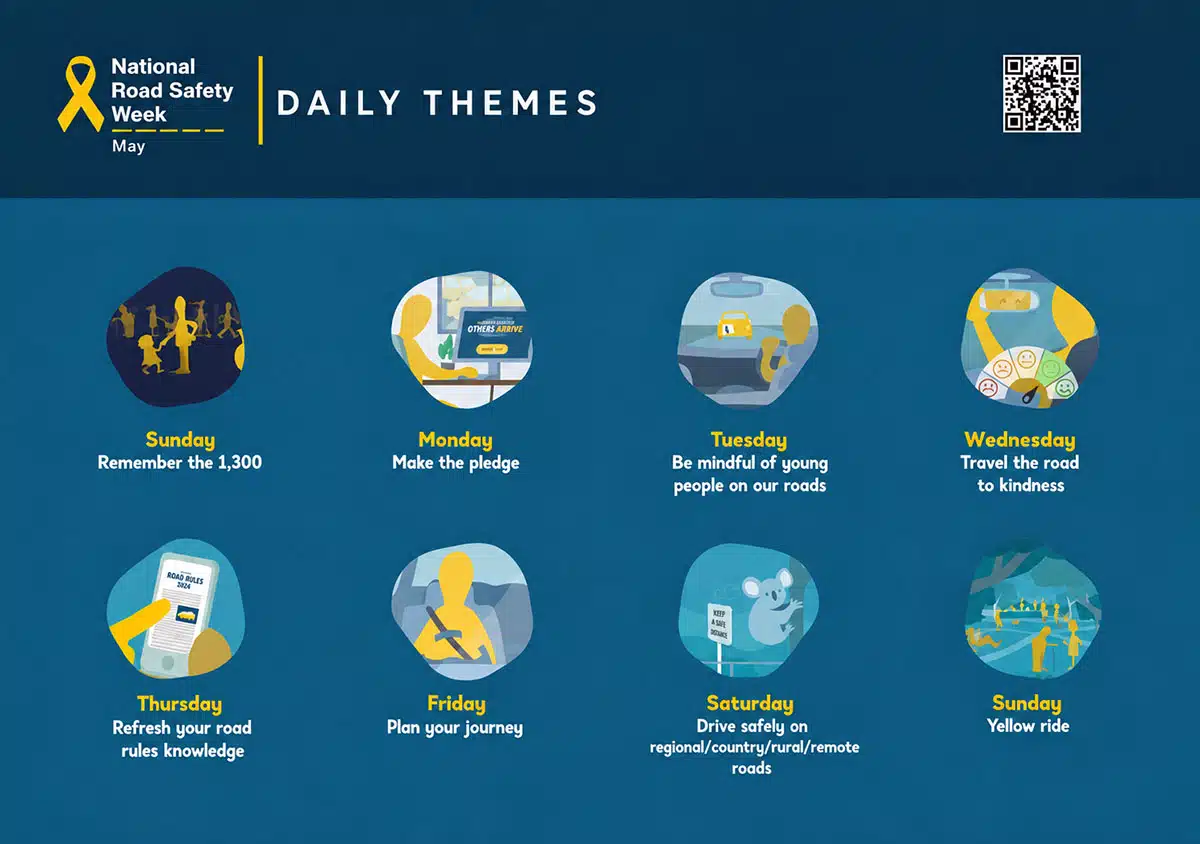
National Road Safety Week Daily Themes
Sydney Charter Bus Australia is committed to road safety
Road safety is everyone’s business, every day of the year. Sydney Charter Bus Australia is proud to support National Road Safety Week and the work of the SARAH Group, and to bring that same commitment to every service we run. We ask all road users to think about how they can actively protect not only themselves and their passengers, but everyone who is vulnerable on the road. Please take a moment to take the pledge, and read more about us and our commitment to safe travel.
#NRSW #DriveSOS