
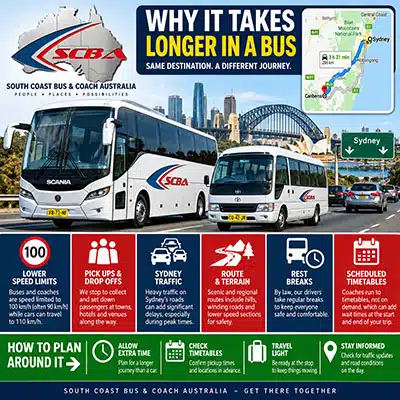
Why Does It Take Longer in a Bus or Coach?
It is one of the most common surprises in group travel: the bus takes longer than everyone expected. A trip that feels like it should take 40 minutes ends up taking an hour, and the natural assumption is that something went wrong. In almost every case, nothing did.
A bus or coach is a very different vehicle to a car. It operates under different laws, carries a full load of passengers, and is subject to boarding, traffic and rest requirements a car never faces. Understanding why bus travel takes longer is the key to planning a group trip that runs to time. Here is exactly what is going on, and how to plan around it.
The Google Maps trap
When people estimate a trip, they usually rely on one of two things: past experience or Google Maps, and both can mislead. “It only took me 40 minutes last time” is true, but that was a car, on a different day, at a different time.
Google Maps is trickier still. The time it shows is calculated for the moment you type in the search, on a “leave now” basis. Plan a Friday-afternoon trip on a Sunday morning and Maps quotes you a quiet Sunday run, not a peak-hour Friday one. Maps does have a “depart at” option that lets you set the real day and time, but very few people know it is there. And crucially, Maps gives you a car’s travel time, not a bus’s.

Buses are limited to 100 km/h
By law, every heavy vehicle over 4.5 tonnes, which includes all buses and coaches, is fitted with a speed limiter and cannot exceed 100 km/h on any road, including motorways where cars may travel at 110. It does not sound like much, but over distance it adds up. On a two or three-hour freeway run, that difference alone can add a noticeable chunk of time, before traffic is even considered.
Mandatory rest breaks on long trips
On longer journeys, the law also requires the driver to rest. Under the Heavy Vehicle National Law fatigue rules, a solo driver working standard hours must take at least a 15-minute rest break within every 5.25 hours of work. At Sydney Charter Bus Australia we go further, capping continuous driving at three hours before a minimum 20-minute break.
These stops are not optional, and they are not wasted time. They are what keeps your group and everyone else on the road safe. They do, however, need to be built into the schedule for any long-distance service, so a trip that looks like four hours of driving is really a little more once a proper break is included. You can read more in our driver fatigue policy.
Getting a group on board takes time
Boarding is the single most underestimated factor, and it is entirely within the group’s control. A bus scheduled to depart at 9:00am rarely leaves at 9:00am. To many people, a 9:00 departure means start arriving at 9:00, and by the time everyone has boarded, stowed their bags and settled into a seat, it can easily be 9:10 or later.
The larger the group, the more likely a few latecomers, and the longer the boarding. That matters most at the worst possible moment, because a 10-minute late departure heading into peak hour can become 30 minutes or more out on the road. Being ready to board before the scheduled departure time is the easiest way to keep the whole day on track.
Sydney traffic and peak hours
Then there is Sydney traffic, which only gets busier. Using any freeway or highway after 3:00pm on a weekday, heading out of the city, can add an hour or more to a journey. Wherever possible, plan around the peaks.
| Sydney weekday peak | Typical times |
|---|---|
| Morning peak | 7:00am to 9:30am |
| Afternoon peak | 3:00pm to 7:00pm |
Positioning time and vehicle handling
There is one more factor many people never consider: the bus does not start at your door, it starts at our depot. The time for the vehicle to travel from the depot to your first pickup, and from your final drop-off back to the depot, is a real and legitimate part of a compliant, depot-based operation.
And a bus simply behaves differently to a car. It accelerates more gently, takes longer to stop, needs a wider path through roundabouts and tight streets, and is driven with the safety of a full load of passengers in mind. All of this is deliberate, and all of it adds a little time compared with a nippy hatchback.
The reasons at a glance
| Factor | Why it adds time |
|---|---|
| 100 km/h speed limit | Buses are capped at 100, so long freeway trips take longer than a car at 110. |
| Boarding a group | Assembling, stowing bags and settling passengers adds 10 minutes or more before departure. |
| Peak-hour traffic | A 10-minute late departure into peak can add 30 minutes or more on the road. |
| Mandatory rest breaks | Long trips require driver rest breaks under fatigue law. |
| Positioning time | The bus travels from the depot to your pickup and back again. |
| Vehicle handling | Slower acceleration, braking and turning than a car, for safety. |
How to plan around it
|
Ask the people who do it every day
The best defence against a late arrival is simple: ask the operator who runs these trips daily. An accredited operator knows how long a given journey really takes at different times of the day and week, and will build your schedule around your must-arrive time. Accreditation is also your assurance of properly maintained vehicles, qualified drivers and realistic, compliant planning. Sydney Charter Bus Australia is a Transport for NSW accredited operator, and our team is happy to advise on realistic timings when you book.
Bus travel time FAQs
Why does the bus take longer than Google Maps says?
Maps gives you a car’s travel time for the moment you searched, not a bus’s time for your actual travel day. Buses are capped at 100 km/h and are subject to boarding, traffic and rest breaks a car is not.
How fast can a bus or coach travel?
All heavy vehicles over 4.5 tonnes, including buses and coaches, are speed-limited to a maximum of 100 km/h on every road, including motorways.
Why does departure often run late?
Because a group takes time to assemble and board. A 9:00am departure often means people start arriving at 9:00, so the bus does not actually move until 9:10 or later. Larger groups take longer.
Do drivers have to stop on long trips?
Yes. Under Heavy Vehicle National Law fatigue rules a solo driver must rest within set periods, and we apply a stricter policy of a 20-minute break after a maximum of three hours’ driving.
How much extra time should I allow?
Aim to arrive 20 minutes early rather than late. Account for a delayed departure, traffic, the bus’s speed and the time of day, and ask us for a realistic estimate.
What is the worst time to travel out of Sydney?
Weekday afternoons. Using a freeway or highway out of the city after 3:00pm can add an hour or more to the journey.
Does group size affect travel time?
Yes. Boarding takes longer with more passengers, and larger groups are more likely to have latecomers that delay departure.
How do I make sure we arrive on time?
Tell us your must-arrive time and we will build the schedule backwards from it, allowing for every factor above. Then have your group ready to board on time.
Plan your trip with realistic timing
The more we know about your must-arrive time, your group size and your travel day, the more accurately we can plan a service that runs to time. Contact us or request an online quote, and our team will help you plan a bus hire service that gets your group there in good time and without the stress.