
School Camp & Overnight Excursion Policy
Safe, Well-Coordinated Transport for Multi-Day School Camps and Overnight Excursions
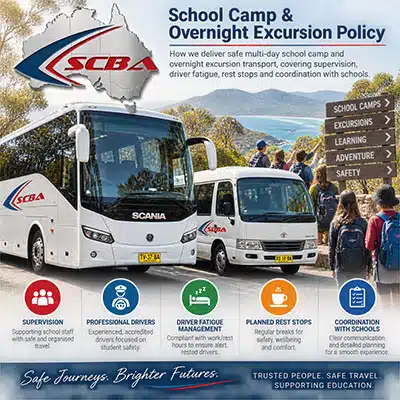
A school camp or overnight excursion is a highlight of the school year, and getting there and back safely is the foundation of a good trip. Multi-day travel brings a few extra considerations, longer distances, driver rest, supervision across days, and coordination between the school and the operator. This policy sets out how we manage all of it, so a camp runs smoothly from the first pickup to the final drop-off.
It applies to any multi-day or overnight school, sporting or camp transport, and it works alongside our commercial arrangements for extended charters. For the driver accommodation and multi-day charter details, see our Extended Charter & Overnight Policy.
Safe Multi-Day Travel | Strict Driver Fatigue Limits | School Retains Duty of Care
Planning and Coordination
Good camps are planned well ahead, which suits us, because we plan our multi-day services carefully too. Clear information up front lets us schedule the right vehicle, driver hours and rest stops.
| Full itinerary in advance | We ask for the full multi-day itinerary, including daily departure and return times, distances and any on-site movements, so we can plan driver hours and rest correctly. |
| Risk assessment support | We provide the operator and vehicle information the school needs for its own excursion risk assessment. |
| Single point of contact | A nominated contact coordinates the trip, and our after-hours contact is available throughout a multi-day camp, not only in office hours. |
| Right vehicle for the route | We match the vehicle to the group size and the roads on the itinerary, noting that our vehicles operate on sealed roads only. |
See our Student Transport Risk Assessment and Unsealed Roads Policy.
Supervision and Duty of Care
On a multi-day trip, it is especially important to be clear about who is responsible for the students, and when. The answer is the same as on any school service: the school holds the duty of care.
| The school supervises throughout | A responsible adult from the school or organising body supervises students at all times, including during travel, at rest stops and overnight. This non-delegable duty of care cannot be passed to the driver or operator. |
| The driver’s role is transport | The driver operates the vehicle safely and intervenes on safety matters, but is not responsible for supervising or disciplining students, as set out in our Passenger Code of Conduct. |
| Head counts at every movement | Head counts and post-trip vehicle sweeps are carried out at each departure and set-down, so every student is accounted for across the whole trip. |
| Medical and dietary needs | Supervising staff carry and manage student medication and medical information; where a medical need requires eating or drinking on board, that is accommodated with prior approval. |
See our Passenger Code of Conduct and Anaphylaxis Management policies.
Driver Fatigue on Multi-Day Trips
Driver fatigue is the single most important safety factor on a long or multi-day trip, and we manage it strictly. Our drivers work to a fatigue policy that is tighter than the standard heavy vehicle limits: a maximum of three hours driving before a break of at least twenty minutes. On multi-day camps, driving hours are planned across each day with proper overnight rest, in line with the Heavy Vehicle National Law and our own fatigue policy. A well-rested driver is a safe driver, and on a camp full of children that matters more than ever. Where a trip is too long for one driver to complete safely, we plan rest or a second driver rather than push the limits. Driver accommodation and meal arrangements for overnight trips are covered in our Extended Charter & Overnight Policy.
⚠ IMPORTANT: Camps Requiring a Hawkesbury River Ferry Crossing
Ferry Crossings: Mandatory 6:30am Departure Rule
Several camps and venues north of the Hawkesbury River, including Webbs Creek Camp near Wisemans Ferry, are reached only by a vehicle ferry across the river. These ferries close for daily and monthly maintenance, and low tide can prevent a coach from safely boarding or leaving the ramp. A missed or closed ferry can strand a coach for hours. To eliminate that risk, the following rule applies to any service that must cross the Hawkesbury River by ferry.
All services crossing on a Hawkesbury River vehicle ferry must depart Sydney by 6:30am so the coach reaches and boards the ferry well before any maintenance closure and while tide conditions allow safe boarding. Where a client requires a later departure against this advice, SCBA reserves the right to decline the ferry crossing, or to charge for any downtime incurred (for example waiting for a ferry closure to end or for the tide to rise), as set out in our Terms & Conditions.
This rule exists for good reason. Peak-hour traffic out of Sydney can add well over an hour to the trip, which can mean arriving after a scheduled closure. Departing by 6:30am gives a safety margin against both traffic and the ferry timetable.
Why the 6:30am Rule Exists: Two Real Risks
| Maintenance closures | Each ferry closes on a set schedule (see table). A coach that arrives during a closure cannot cross and must wait for it to reopen, which can be several hours. Departing Sydney by 6:30am puts the coach on the ferry before the morning closure windows. |
| Low tide and the ramp | Transport for NSW specifically warns that vehicles with a long overhang, which includes coaches, have problems boarding at low tide. At low tide the ramp angle is too steep and a coach can ground on the wharf or ramp, becoming stuck until the tide rises or the vehicle is towed. Crossing early, before the tide drops, avoids this. |
Hawkesbury River Vehicle Ferries: Closures & Details
The table below sets out the vehicle ferries across the Hawkesbury River and their scheduled maintenance and daily closures. Ferries are free and run on demand, but these closures are when a coach can be caught out. Always check the live status before travel, as times can change.
| Ferry | Operating Hours | Maintenance / Daily Closures | Coach Suitable? |
|---|---|---|---|
| Webbs Creek (Wisemans Ferry) | 24 hours, 7 days | Maintenance: 1st Tuesday of each month, 9:30am to 1:00pm. Daily closure: 2:00am to 3:00am. | Yes (24-car). Low-tide overhang risk. |
| Wisemans Ferry | 24 hours, 7 days (2nd ferry weekends/public holidays 9am to 5pm) | No fixed maintenance closure (second ferry covers maintenance). | Yes (24-car). Low-tide overhang risk. |
| Sackville | 24 hours, 7 days | Maintenance: 1st Wednesday of each month, 9:30am to 1:00pm. | 15-car. Confirm suitability first. |
| Lower Portland | 6:00am to 10:00pm (half-hour breaks 10:00 to 10:30am & 6:30 to 7:00pm) | Maintenance: 2nd Wednesday of each month, 9:30am to 1:00pm. | No. Small ferry (8-car, 48t). Not for coaches. |
| Berowra Waters | 24 hours, 7 days | Maintenance (from 1 Nov 2026): 2nd Tuesday of each month, 9:30am to 1:00pm. | No. Vehicles over 7m cannot approach. |
Source: Transport for NSW, Vehicle ferries. Live status: Live Traffic NSW. Times are subject to change and should be confirmed before every trip.
Driver Working Hours on Multi-Day Trips
On a multi-day charter there is no depot at either end of the day, so the driver’s working day includes more than just driving. We plan each day to a maximum working limit to keep the driver safe and compliant.
| Maximum 12-hour working day | A driver’s total working day on a multi-day charter is capped at 12 hours. |
| Up to 10 hours charter driving | Of that, a maximum of 10 hours is available for the actual charter, within our fatigue policy of three hours driving before each break. |
| Plus around 2 hours sign-on and sign-off | The remaining time covers daily sign-on and sign-off, pre-trip and post-trip vehicle inspections, refuelling and cleaning, which on a multi-day trip happen away from a depot. |
| Rest and a second driver | Where an itinerary cannot fit within these limits, we plan additional rest or a second driver rather than exceed them. |
These limits reflect the reality that a multi-day charter is not calculated depot to depot, and that a rested driver is a safe driver. See our Driver Fatigue Compliance Policy.
Driver Accommodation & Meals on Overnight Trips
On any trip that keeps the driver away overnight, the hirer covers the driver’s accommodation and meals. This is standard for touring and is itemised clearly. A properly rested, well-fed driver is central to the safety of a multi-day trip, so these are not optional extras, they are part of running the charter safely and lawfully. Full commercial detail is in our Extended Charter & Overnight Policy.
| Requirement | Standard (all at the hirer’s cost) |
|---|---|
| Driver accommodation | A minimum three-star standard room, with the driver’s own private room, own private bathroom, and a television. Shared or bunk-style accommodation is not suitable for a working driver who must be properly rested. |
| Meal allowance | A daily driver meal allowance applies on overnight trips, covering breakfast, lunch and dinner. |
| Meal allowance still applies if meals are provided | The meal allowance applies even where the camp or venue provides catering. Drivers keep their own schedule around driving and rest breaks, which rarely matches group meal times, must remain independent of the group, and may need to eat off-site or at different hours. The allowance ensures the driver can eat properly regardless of the group’s arrangements. |
| Confirmed before travel | Accommodation and meal arrangements are confirmed with the hirer before the trip, so there are no surprises. |
Coach Parking at Overnight Accommodation
Where the driver stays overnight, the accommodation must be able to safely park the vehicle. Coaches cannot be left on the street overnight, so this needs to be confirmed when the accommodation is arranged.
| Off-street parking | Accommodation must provide off-street parking for the coach or minibus. On-street overnight parking is not acceptable. |
| Safe and secure | The parking area must be safe and secure, protecting the vehicle overnight. |
| Sized for the fleet on the trip | Parking must suit the vehicles on the trip: multiple coaches where several are used, or a single coach or minibus. Where a single vehicle also tows a luggage trailer, the parking must accommodate the vehicle and trailer together. |
| Confirmed in advance | Suitable parking is confirmed before the trip as part of finalising the accommodation. |
⚠ Important: Onboard Toilets Are Not in Use
For safety reasons, where a coach is fitted with an onboard toilet, it is not available for use during travel, under our work health and safety policy. A passenger standing or moving to use a toilet while the coach is in motion is at serious risk of injury in the event of sudden or emergency braking, exactly the situation seatbelts and remaining seated are there to protect against. Keeping everyone seated and belted while the vehicle is moving is a core safety rule, and it applies here too.
Instead, we build regular comfort stops into every trip. On camps and long-distance travel, rest and comfort stops are scheduled along the route, which also align with our driver fatigue breaks. Everyone can use proper facilities safely off the vehicle, and the trip continues comfortably. If your group has a particular need, tell us when planning and we will schedule stops to suit.
Rest Stops and On the Road
Long drives are broken up for the comfort and safety of everyone on board.
| Scheduled rest stops | We build rest and comfort stops into long-distance legs, both to meet driver fatigue requirements and to give students a break to stretch and refresh. |
| Meals off the vehicle | In line with our Food & Drink policy, meals are taken at stops rather than on board, which keeps the vehicle clean and fresh for the whole camp. |
| Seatbelts throughout | All vehicles are seatbelted, and passengers remain seated and belted while the vehicle is moving on every leg. |
Safety, Weather and the Unexpected
Camps often travel into regional NSW, where weather and road conditions can change. Safety always comes first: where bushfire, extreme weather or road disruption affects a route, we follow the advice of the NSW authorities and may delay, reroute or adjust travel in consultation with the school. This is set out fully in our Bushfire, Extreme Weather & Route Disruption policy. Any incident on a multi-day trip is managed and reported under our Emergency & Incident Management policy.
See our Bushfire, Extreme Weather & Route Disruption Policy and Emergency & Incident Management Policy.
Our Commitment to Your Camp
A school camp should be remembered for the experience, not the trip there. When you book Sydney Charter Bus Australia for a multi-day camp or overnight excursion, you can be confident the driving is planned around strict fatigue limits, the vehicle is right for the route, the responsibilities are clear, and we are contactable throughout. We get your group there and back safely, so the school can focus on the camp itself.
Planning a School Camp?
Tell us your dates, destination and group size, and we will help you plan safe, well-coordinated multi-day transport.
NSW Accreditation No. 39461 | Operating Since 2003 | Ph: 1300 468 199 | Mobile: 0413 182 999